How Community Identity Influences the Marriage Search
In India, marriage has never been an individual thing. It bears the burden of family pressure, culture, and belonging to the community. Although the way individuals engage their potential partners has evolved significantly during the last 20 years, the priorities embraced by most communities have stayed quite similar: mutual values, similar backgrounds, and the acceptance of the family.
What has changed, however, is the method. Extended networks and local intermediaries that once served as the backbone of families are now approached with a much more structured approach by the family.
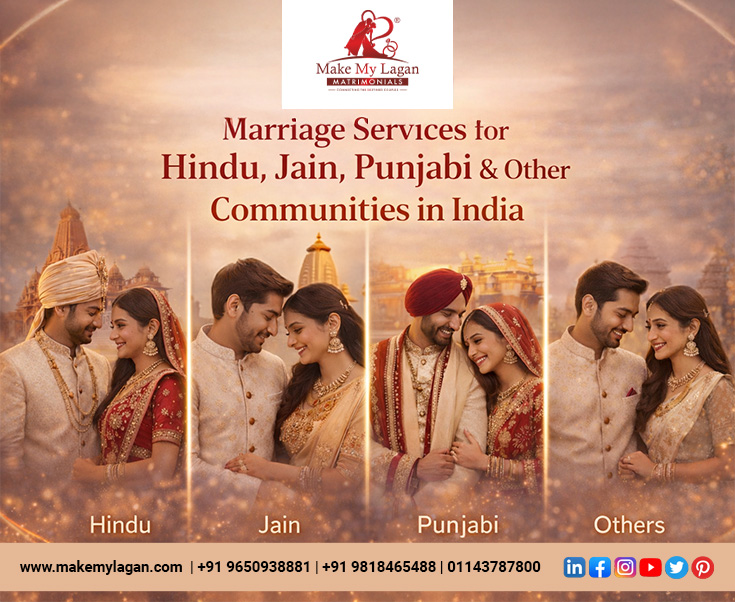
Professional matrimonial consultancies have also enabled the communities to retain their traditions and gain the effectiveness and access that the expert advice can offer. This change is evident in some communities in northern India, but none more than the Punjabi matrimonial, Jain matrimony and Baniya matrimonial families, all of which have their expectations of the matchmaking process.
Punjabi Wedding Rites: Spirit, Family and Common Ground
Punjabi Match Priorities as Held by the Families
The Punjabis have a tradition of a warm family, very well-bonded family structures, and a strong sense of community. These values, in Punjabi wedlock investigations, are converted into exceptionally particular inclinations, a mate who will integrate perfectly into a larger family, who will embrace cultural celebrations with zeal, and whose shape will align and not conflict with that of the family.
The regional identity is also significant. Regardless of whether a family is based in Delhi or Punjab or the diaspora, there is a general inclination to stay with a partner who is conversant with the cultural allusions, language and practices that characterise the life of the Punjab. In addition to this, learning and career have been of more importance, especially in younger families who are balancing between tradition and modern desire.
Changing Tendencies of Modern Punjabi Matchmaking
A significant change in recent years is that the input of individual users in the search is increasing. Although younger adults were used to being passive during marriage decisions, the elders of the family, in turn, tend to back them. This has pushed matrimonial consultancies to evolve, providing services that fulfil the family unit as well as the individual at the same time, such that the introductions would fulfil both the generational points of view.
Jain Matrimony: Ethics, Spirituality and Way of Life
The Charismatic Matchmaking of the Jains
Jain families have a clear philosophical outlay, approaching matrimony. Non-violence, restraint and ethical life are not just the religious values and principles but the practical values which make everyday life – and, by extension, the expectations set of a potential partner. Jain marriage has great importance in compatibility based on dieting, religious devotion and conformity to the cultural practices of the society.
Such particularity necessitates some kind of subtlety that generic platforms frequently cannot offer. A family in the Digambar or Shwetambar traditions, e.g. is not merely sifting by religion; they are seeking a mate who shares the same ethical inclination in the entirety of his or her lifestyle. Those professional consultancies that have a clue to this difference will be much better placed in making meaningful introductions as opposed to those that lump all religious communities into an interchangeable category.
Baniya Matrimonial Practices: Business, Principles and Family Cohesion
What in Baniya Communities Makes Two Compatible
Baniya has been traditionally linked to entrepreneurial spirit, fiscal conservatism and well-knit families. In the case of baniya matrimonial searches, these attributes usually serve to guide what families seek when looking at a potential match, not necessarily with respect to profession, but with respect to temperament, a long-term orientation, and the values that inform the way a family handles its affairs over the generations.
It is also significant that sub-community compatibility is emphasised in the larger Baniya groups. Families often put a priority on same or almost related sub-caste partners, and therefore, any matchmaking service they involve must have a clear understanding of these differences. An excellent matrimonial consultancy does not merely understand that a customer is a Baniya sub-community; it knows what sub-community the customer is in and what specific expectations it comes with.
The Overlapping of Communities
Although there are many differences between Punjabi matrimonial, Jain matrimony, and Baniya matrimonial traditions as compared to each other, there is a common principle underlying, that is, marriage founded on true compatibility, including cultural, personal, and familial factors, is much better bound to last as opposed to one founded on convenience factors only. The difference is not the value attached to that compatibility but the content of the compatibility, which is the matter of it.
This is the very reason why community-based matchmaking has not become obsolete despite the transformations that society is experiencing around it. Families are becoming exact, not inflexible. And exactness, in the question of matrimony, is a virtue instead of a restraint.
About Make My Lagan
Make My Lagan is a Delhi NCR-based matrimonial consultancy firm that deals with families of various communities in the north of India. Its strategy incorporates formal consultation, comprehensive profile checks, and culture-based advice to make sure that all the introductions are based on actual compatibility. Such a team realises that there are no two communities like, and there are no two families like, and it develops its process based on that fact. To the individuals who want a consultancy that complements their values as attentively as it complements their profiles, Make My Lagan would be contacted through makemylagan.com.
Conclusion
Community-based matchmaking is not a thing of the past – it is something that still exists and develops according to the needs of contemporary families. These communities that have always highly valued cultural alignment when it comes to marriage have not ceased to do so; they have just discovered more cultured means of achieving it. The more perfect matchmaking consultancies become in the knowledge of community subtext, the more families become introduced to the type of person that they are and the type of person they aspire to become.
FAQs
What is the differentiator of Make My Lagan in Punjabi matrimonial match-making?
Make My Lagan is dedicated to the matrimonial services of Punjabis, which provides tailored matchmaking considering cultural values, regional identity, and family relationships in terms of individual preferences.
What does Make My Lagan do to meet the traditions of Jain matrimony?
Make My Lagan has an insight into the peculiarities of Jain marriage and provides culturally competent matchmaking services, giving more emphasis to ethical life, devotion to religion, and compatibility of lifestyles in meaningful relationships.
What is the reason to select Make My Lagan as a baniya matrimonial matchmaking?
Make My Lagan is the best in Baniya matrimonial service, whereby the sub-community compatibility, entrepreneur spirit, and long-term family sustainability are the key aspects of getting a match-perfect Baniya family.
What is community-based matchmaking? How does it work?
The business model of Make My Lagan in relation to Punjabi matrimonial, Jain matrimony and Baniya matrimonial is based on a thorough insight into the cultural, familial and personal compatibility in long-term matchings.